Monday, November 25, 2013

USEA Area 1: Enabling Life Long Learning

When I opened the email congratulating me on my USEA Area 1 Scholarship, I squeed just a little bit. That February, I had moved to Strafford, VT, conveniently up the road from Denny Emerson.  My two young horses were a few months back into work after a five month hiatus, and I was grateful to be at Huntington Farm with an indoor.  Things had been progressing with Suki, my six year old OTTB mare, on the flat with the help of Deborah Dean-Smith, but starting back jumping had been, well, somewhat heart stopping for onlookers.  A line of rails on the ground had almost landed me out of the ring and onto Route 132 when Suki decided it was such a big deal to trot through that her best bronco impersonation was entirely necessary.
Clearly, I needed help.

When I applied for the USEA Area 1 Scholarship, I had to lay out how I wanted to spend the funds.  This was an easy choice for me, as my experiences with Denny Emerson in the past had been very rewarding.  I have always appreciated his desire to teach bigger concepts and his honesty.  As someone who enjoys the act of learning and discovery for its own sake, I knew that I could not only gain positive experiences from working with him, but I could learn concepts that I could apply to my other youngster and those to come.

Learning with young horses does not start when the instructor walks in the ring.  Depending on the horse, even hauling to a lesson can be a learning experience.  Lucky for me, Suki did remember how to haul, how to stand quietly to mount, and that is about where her memory stopped.  She was excited about being in a new place.  And there I was, in a ring that has always made me nervous, probably because I love to pile too much pressure on myself, trying to convince my mare there as no reason to be excited.  As Denny walked into the ring, he quickly assessed the situation.  He had me approach a tiny cross rail and Suki balled herself up and sprang over it, not exactly the picture of nonchalance.  He told me to walk and trot around while others jumped so she could get used to the atmosphere and we could play over small things at the end, but that it would not count as a lesson.  I was blown away by his generosity when he also gave me an invitation to bring her up to the farm a few times to just walk around and get used to her surroundings before having our first "real" lesson.
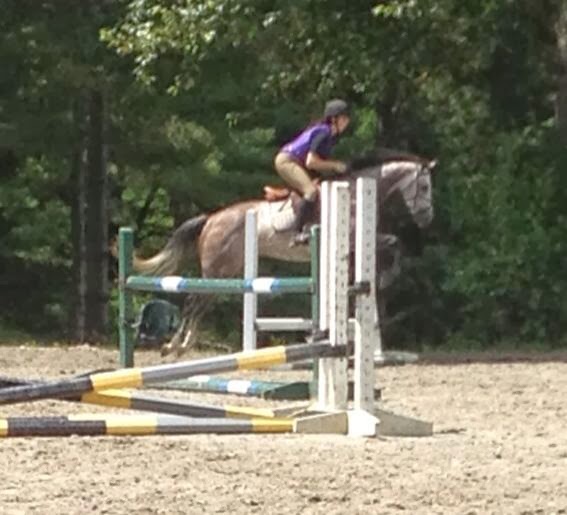

9" or 2'6"?
Atomic Mare isn't taking any chances.
We took Denny's advice, hauling up to the farm to hack around, and Suki was a bit calmer when we began our first lesson.  Lucky for me, it was quite a warm day so Denny emphasized using the heat to tire her out a bit.  She needed to learn to approach a jump calmly at the trot, hop over it, and calmly saunter off.  Anytime she was too excited, she "earned" more tiny fences until she was consistently casual.  That was her end of the bargain.  As an "intense" horse and rider pair, I had my end of the balance to work on.  I had to work very hard not to grab when she got quick as it accentuated her desire to get quick because of her anxiety about being trapped.  It was very hard for me to just let go.  However, by the end of the lesson, between repetition and heat, we had both knocked our level of anxiety down several pegs to end on a very positive note.


The horse I brought to the second lesson, though she looked exactly the same, behaved in an entirely different manner.  She was very relaxed, so we got to do a bit more.  After calmly hopping and plopping small fences in the ring, we introduced cross-country elements on the longe.  Though she had gone BN as a four year old, the refresher without any rider input was necessary to maintain her level of relaxation.  Denny determined she was a very sensitive horse and if I get at all tense, our collective level of intensity would leap upward.  She also was introduced to cows, which she was completely calm about.  Apparently, she had remembered that part of her experience roading hounds passed cows.  We jumped some more under saddle and ended on a very positive note.  My homework, my permanent homework, was to work on not internalizing all my worries.

Our third ride turned out to be a surprise cross country school.  Suki warmed up softly, jumping casually, and off we went with Denny on Cordi to go school cross-country.  We worked on jumping with terrain questions, something that I was not entirely comfortable with on her yet.  She has always had this momentous hind end that pushed the rest of her along with it, and I need to let go and be confident in her ability to balance herself.  Funny thing, she is much more able to balance herself without my nitpicking.  She was game to jump everything, including a cross rail in and out of the water.  I was pleased.  Denny told me my horse had given me a great wedding gift in that ride.  I suppose I should mention that this lesson was a few days before my wedding.  No one at Tamarack or at Huntington could figure out how I was riding, never mind jumping, right before my wedding.  But there I was because, quite honestly, it was the only thing I could do and feel like my head was screwed on straight.
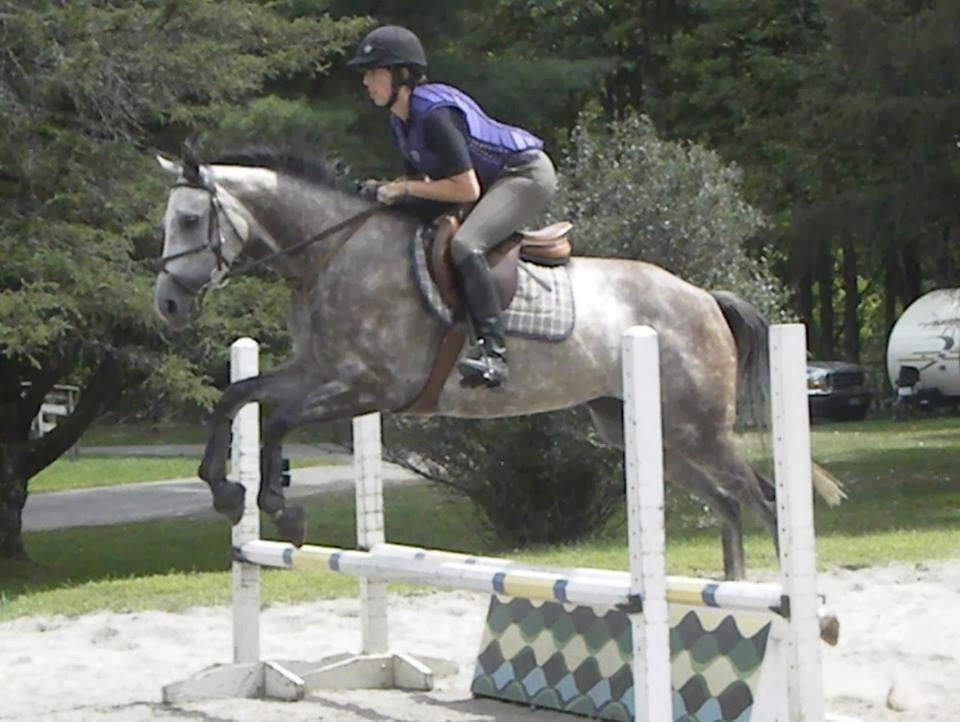
The Flying Sausage!
(According to *someone*, my TB is "fat")

Our last scholarship enabled lesson was a group lesson with two women from Flatlands that were getting ready to go Beginner Novice at GMHA.  Suki showed up that day with her "A" game.  Denny discussed the importance of balance versus impulsion, some that is a very fine line to dance, particularly with a horse as sensitive as Suki about aids.  It is very easy to get enough impulsion with her, but sometimes hard to negotiate requests for balance without crossing the line into making her feel trapped.  We also worked on counting the rhythm for the canter, out loud, which helped me maintain a quality canter.  She is sensitive enough that the act of thinking about the canter I want with the rhythm I want, is generally enough to cause the subtle changes in my body required to get that canter, rather than over applying my aids.  We approached a set of barrels with a rail, and she approached it perfectly, jumping out of her skin over the top of it, and as I landed gasping because she damn near cracked me in the sternum, I heard Denny yelling to me, "Did you feel that?  Make her do that again!" as he ran for his camera.  And while I could not make her jump quite that big again, she was jumping miles from where she was just a few lessons before.

I did not stop riding with Denny after my scholarship ran out.  Suki has come even further since then, jumping gymnastics like a pro and channeling her intensity for good instead of drama.  And, somewhere in all of that, I have become a whole lot more comfortable riding her.  Its not so much that I have ever been uncomfortable with her antics, per say, but I have this overwhelming desire to not make a mistake that results in a complete lock up.  Denny helped me significantly with my want to be good by putting the situation in perspective: if I wanted to keep riding my mare, I needed to become the kind of rider she needed me to be.  I needed to stop trying to be so controlling and allow my horse a bit of independence.

What keeps me coming back to Denny for help with my youngsters is his demand that his students be students of riding, not in it for the quick fix or one magic exercise; but, diligent pupils that accept that "things take time."  He is so supportive of starting young horses right that he also allowed me to bring my four year old, Salt, over to school in the ring and, subsequently, was very patient when I tried to have my first lesson over fences on him.  When I say tried, I mean he was not quite ready for working around other horses, but he learned a great deal and ended up trotting boxes under saddle as well as school XC on the longe.  Next year, I hope to bring him to Denny's and continue our education.  But, until then, I will be slowly laying down the foundation for that endeavor to be successful.

I will never forget the day during Adult Camp many years ago, when I was struggling with my horse Spot, a OTTB that lived most of his life behind the vertical, and Denny told me that I really ought to keep him at BN instead of moving up.  Years later, having competed Spot Training under her tutelage, Sue Berrill told me that they were pretty sure I would not come back after getting that honest response, as many don't.  But, I did.  Why?  Because I will also never forget the story Denny told about riding being able plateaus and suddenly realizing that the one you are on now is much higher than the one you were on before.  That before you know it, you'll be a mile ahead, not by focusing on how dreadful things are now; but, by sticking it out and accepting all good things come in time, with hard work.  If you had told me during that first non-lesson lesson that my horse would be casually schooling gymnastics and jumping a novice sized oxer off a long approach when the windchill made it below freezing this fall, I would have stared at you in disbelief.  However, through the generosity of Area 1's scholarship program, the patience of a great teacher, and a lot of hard work, it happened.  I have found myself a mile further on my journey as a life long learner.

Monday, November 18, 2013

"I don't know how to do this"


"Yes, you do."
"I can't."
"Well, can you find the density of this substance?"
"Yes..."
And so the conversation goes, until the student figures out the answer and I don't actually tell them much of anything.  It usually ends with my saying, "I thought you couldn't," and walking away with a wink.

This process is one I seem to go through constantly as a high school math/science teacher.  Both these subjects seem to be wrought with a whole lot of, "I can't possibly."  So does, it seems, training young horses.

The similarity hit me when trying to teach my leggy (not allowed to be) 17h OTTB to canter on the longe in side reins.  He couldn't possibly.  He could possibly prop, throw a fit, buck, run backwards, bolt, and do a very believable impression of a Standardbred.  But not canter on a circle.
So, after dancing a futile dance, chasing, clucking, cracking the whip, ducking, weaving, and doing my best impression of waterskiing, I decide to change the game.
"Do you remember how to whoah and yield your haunches at the walk?"
Yes.
"Do you remember how to trot off and whoah, square to me, when I drop my shoulder?"
Yes.
"Can you do these things until you're head is down, you're chewing, and relaxed?"
Yes.
"Can you canter?"
Yes.

Learning new things, especially when you are young or underconfident or both, is all about building on what you know.  It is about building confidence and maintaining a positive affect while being faced with new situations.  The worried mine, the stressed mine, hopped up on adrenaline and/or cortisol, cannot learn as effectively.  It does not matter if you are a horse or a human, "I can't possibly" is not a mindset that is conducive to learning.  Set your horse (and yourself) up for "can possibly" moments by building in small steps.  It's like trying to learn math, start with pre-algebra, not Calculus.

Friday, November 8, 2013

Take the Ball and Run with It

A few weeks ago, Denny summed up the entire personality of my horse in one short phrase, "free spirit."  He told me she was inclined to want to do things her way and I was just going to have to learn to deal with it, abandon my tendency to want to over control, and go with the flow if I wanted to ride her well.
This idea has change a lot about my riding, not perminantly (yet), but my approach has changed.  I was having a heck of a time with left shoulder in, so I let go of the left rein and, go figure, there it was.  Canter work, particularly left, has been hard because she does not enjoy feeling out of balance.  I let go of trying to force her into balance and started playing with exercises the force her to balance herself on her own terms, such as shallow serpentines.
I took that information and applied it to something my dressage trainer, Deb, told me: hold the right contact going left.  I thought to myself, do I even have right contact?  Or is what I'm holding just pressure with nothing behind it.  So, again, I left go of what I thought Was contact and asked her to come into it with a lot of exercises and a lot of encouraging outside leg.
Let go.
Set her up for making the decision herself.
Try not to be a control freak.

These are the driving ideas behind what I am trying to do with my mare.  I took a concept and ran with it.

And I'm sure it will run me into some trouble, it already has.  Suki does not always make decision I agree with.  For example, she turned 10 feet too early onto a "trail" at a dead gallop in the woods while I was trying to retrieve a stirrup.  But, I survived and she did not put a foot wrong.
Somehow, I doubt that's what Denny intended for me to do by letting her be the free spirit she is, but I can tell you he commented on how much more comfortable I seemed on her during my next lesson.

I suppose any time you go through thick forest on a horse, burying your face in the neck to avoid being cracked by a branch and shoving yourself back on by pushing off the trees she is dodging, your participating in some sort of trust building exercise.  It's like submersion therapy for the type a personality type: relax and go with it or have a Wylie-Coyote moment with a tree.

Sunday, October 20, 2013

"The greatest of teachers won't hesitate"

"The greatest of teachers won't hesitate to leave you there by yourself chained to fate" - Live

Depending on who you are, what you want from a riding instructor can differ greatly.  Personally, there is even a difference in terms of teaching style between what I want from my dressage instructor and that I want from my jump instructor.  Lucky for me, I have two very different instructors that fit my very different preferred learning style for each discipline.

My dressage instructor, Deborah Dean-Smith, is well verses in working with sensitive mares.  She was also an upper level event rider before becoming a Grand Prix dressage rider.  She teachers very methodically and works very hard to make sure exercises as well as the attitude of the rider set the horse up for success.  She instructs every step of the way, whether it be to, "flex a little to the outside right...now," or "ask for just a touch more from the inside leg," and so on.  For dressage, I find it much easier to learn via exercises, incredibly direct instruction, and very specific homework.  After years of riding in group lessons for my IHSA team where it was assumed I knew how to ask for shoulder-in because I could get a lesson horse to do something that slightly more resembled the general idea of maybe the horse being on different tracks, the transition to "real dressage" has been a wonderful thing that has transpired through the help of several knowledgable instructors.  Now, I am very happy to work with Deb who somehow manages to always stay right next to me, no matter what I'm doing, and has impeccable timing to help my timing with my aids.  She is also fantastic about providing me with very specific exercises to work on that I can then easily expand upon in between lessons.  The icing on the cake has been the tone she sets for me right before I walk in the dressage ring.  What she said to me, I'll never tell... but, it made me laugh enough to relax both myself and my sensitive little mare.

I have been working with Denny Emerson to hone Suki and my jumping.  He is a vocal advocate of starting young horses off slowly and correctly, so he was the perfect person to go to when I was transitioning Suki from my back burner project horse to my main competition horse.  His enthusiasm for the OTTB and "it takes time" is one of the things that inspired my essay for the Area 1 Scholarship I won this year, the results of which will be the subject of a blog post next month.  However, this is not the only reason I have been jumping with Denny.  The most important reason I jump with Denny is the way he teaches works very well for me.  He teach broad concepts and then expects you to figure out how to apply those concepts to the exercises he has you go through.  The instruction is not usually as direct as "KICK NOW" (though it can be), but tends to be more on the Socratic side of the spectrum, "what did you think of that jump?  Did you feel that?  What could you do better?" with a good mix of, "what on EARTH were you thinking?!" which is what I want when I'm jumping.  I like to think of myself as a reflective person, someone who tends to analyze (and maybe, sometimes, overanalyze) aspects of a ride to improve up what I'm doing for the future.  With the focus being on discussing the physical concepts behind what I am expected to do, I have an easier time doing.  That, and a swift, appropriately timed kick in the ass occasionally never hurt anyone.

Both my instructors, however, approach my horse similarly.  They respect her as a sensitive, athletic horse that, sometimes, requires just sitting, waiting out, and abandoning a little bit of my inner control freak.  Making the effort to understand my horse as an individual is the most important criteria I have for anyone I train with.

Thursday, September 26, 2013

usually, only the embarrassed are the ones that remember that moment


Today probably goes down as one of the worst lessons I have ever had.  Take your pick as to why: being mortified by crying out of frustration, my not stopping horse throwing on the brakes at cross rails, or my back refusing to stop seizing.  The last bit started when I tried to clean my house earlier and my husband told me I should not try to ride.  Lesson learned: don't clean my house (and maybe listen to my husband, but only maybe).

It highlights something the atomic mare has been forcing me to do lately: keep everything in perspective.  I found out three weeks ago If she doesn't jump for a month, she starts making a to-do about jumping again.  So it is back to square one, though going forward does not take as long.  Her flat work has taken more patience that I knew I had and trusting the trainer I started working with this past spring, even when I was totally giving up hope.  I am eternally grateful that asking for the left lead now results in the lead I want, sometimes, rather than running sideways at Mach 10 or kicking out hard enough that I see feet flying next to my head (still can't figure out how that works).  Staying in the game has required a lot of reflection on the three steps forward, two steps back phenomena... Remember, this means you still get some where, just not as fast as you think you ought to.

Where you think you ought to be, now that's a funny thing in itself.  What is that really based on?  Erroneously, I base my thoughts on everyone around me.  I see people the same age as I am doing things faster with horses than I do and go the places I dream I go.  But, basing my ought to-s on that is a mistake.  It does not take into account all the other factors or what they do to achieve them and what personal goals I have already accomplished.  Comparing yourself to others is not worth while, especially when you may not even be aiming for the same goals or have the same obsticles to clear on the way.  Hell, some of their accomplishments may come at a price you wouldn't be willing to pay.

Here are some things I have always wanted... And I mean little girl dreams:
- have my own farm
- get a track horse and retrain it (I started applying for the TRF adoptable horses as soon as I moved to MD at 14 and based a spreadsheet analysis of why I should own a horse versus lease on buying a track horse, which was presented as part of a larger plea to my parents)
- compete at Fair Hill on a horse I found and built up from scratch

Here is how far those dreams have come:
- I own 23.5 acres in horse country and my husband is building a run-in shed.
- I have two OTTBs I found myself and sold a third a while ago
- well, once we get to BN, who knows ;)
Guess I'm not doing so badly.

Last spring, I could not canter without the atomic mare exploding nor could I go near a cross rail outside without massive drama.  Rails on the ground one day sent her broncing badly enough we almost jumped out onto the road.  So, today may be on my current top ten list of terrible rides, but I can't remember some of the former list makers, so they can't matter that much in the big scheme of things.  

Saturday, August 24, 2013

help me help you

I'm writing this while waiting for riders to come through the water and, depending on their division, jump the fence afterward.  The walkie-talkie lets me know when a rider is headed my way.  Behind me a brook runs.  The air is dense with mosquitos and I am coated in chemicals I'd rather not think about.  Since it's a schooling show, I have my rubber boats on and have led two eliminated elementary riders through my obsticle.  You might wonder why on earth I would want to spend my time fending off bugs and carefully watching a fence.  It's two fold.  One, watching people jump is very educational.  You can see what works and what doesn't.  You can learn to see and hear a good canter as well as a distance.  I have, for the most part, learned to see trouble from further out than the rider probably notices (I have also been that rider, taken by surprise, on several occasions).  I also sit here because someone has and will sit here and elsewhere for me.
Several course walkers have thanked me for volunteering.  My response is, "you're welcome," but, inside my head there exists a shpeal.
Please, walking rider, volunteer so there is someone sitting out there when I go out.  If you do, thank you.  If you haven't yet, what is holding you up?  I've boarded at two different barns that hold events and have watched them scramble for judges.  I've judged three or four fences at a time.  This leads me to believe there are many riders out there that have not spent their day sitting, watching, waiting, and taking the brunt of rider frustrations.  What are you waiting for?
I ask you, people who thank me, thank me by scheduling in not only those competitions you plan to ride in, but those you plan to volunteer at.  If your horse goes lame and you have to scratch, go anyway.  Professionals, i know you can't always volunteer, send your non-competing clients in for you.  It is important to keep your profession going.  I know there are professionals that do this.  
Organizers need you.  They need you not just to jump judge, but to scribe, ring steward, and run for rails.  They may even need you to help set up the day before (before 3, of course).  So, get out there.  The jumps don't set themselves and the scores can't be posted online if no one is out there judging.

Tuesday, August 20, 2013

Forgetting How Green Green Is


Yesterday, I took my green OTTB to Denny's to get my first hop-n-plop lesson with him.  I had previously hopped him over a xrail, both in hand and under saddle, and he had visited Denny's, in hand, once before.  Recently, I've been toying with the idea of cantering as I has assumed walk/trot was going well enough, so I focused more work on longeing with side reins to get the canter.  Yes, this horse is quite green.  He was purchased from a trainer at Suffolk as a two-year old and I turned him out for a year or so because his sheer size (16.2h at purchase) and awkward movement on anything but a straight line suggested waiting out the overgrown puppy stage was beneficial to all involved.  And it did, he grew into his legs as a four year old.  But, still...
Green.
He has hacked out some and had negotiated the fake ditch as well as the real water at Huntington, so he is at least willing to give various things a go.  So off to Denny's we went.
Longed, mounted, and started walking around.  Everything was going fairly well for a first excursion until the horse we were riding with started cantering.  Enter ants-in-pants horse.  Also, I did not quite realize how powerful, short backed 17h of horse could feel when balled up.  Back to longeing.  Denny, being put-in-the-time-with-young-horses guy he is, sent the other horse around our longe circle, keeping him far enough away to be safe and had him keep coming close enough to be part of desensitizing Salt.

This is when I realized I was spoiled by the first OTTB I pulled from the track myself, Suki.  She never cared about horses running behind her or around her.  We were over taken on our first XC course and while I saw my life flash before my eyes, she saw no reason to hurry.  I was spoiled.

Green is green.
So, I got back on after Denny returned from taking the other horse on a XC school (reasons I love riding with him: I can trust he won't push for my youngsters to go into an unsafe situation).  Salt was pretty good, reasonable about the next horse to join us.  On the other hand, I do not need to treat my youngsters like they are made of glass.  This is usually around where I start riding badly.  Much like throwing myself up my horse's neck is not an effective driving aid, curling up into semi-fetal position on my horse does not make them more comfortable.  Riding like they know a little more than they do seems to encourage much more confidence... Just do it.

Even still, I forgot how green green is.  He was wiggly.  He is not steady.  At one point turning right because very difficult.  Then, not leaving the ring became difficult.  Funny thing, he definitely chose the "gate area" which is further from the trailer as the gate and acted as though leaving the ring closer to the trailer was not an option since we had not traversed there.  It was like an invisible fence (Denny's ring is not enclosed).  

Our homework:  find a steady eddy to hack a lot with to avoid Salt getting a bit nappy about the ring.
Which means finding a good rider to hack my other horse with me (or taking Denny up on his generous offer to let me tag along on trail rides at Tamarack).

Why?
Because green may be very green... But Suki is finally moving into more of a chartreuse hue.

What color is a well broke horse anyway?  What gradient are we on?